Roll call. Read it out loud.
Stay ready so you don't have to get ready.
The perfect training tool. Keep a deck in your pocket, in the office or at the screening station, ready when you are. Keep complacency out of yourself, your team and your program.
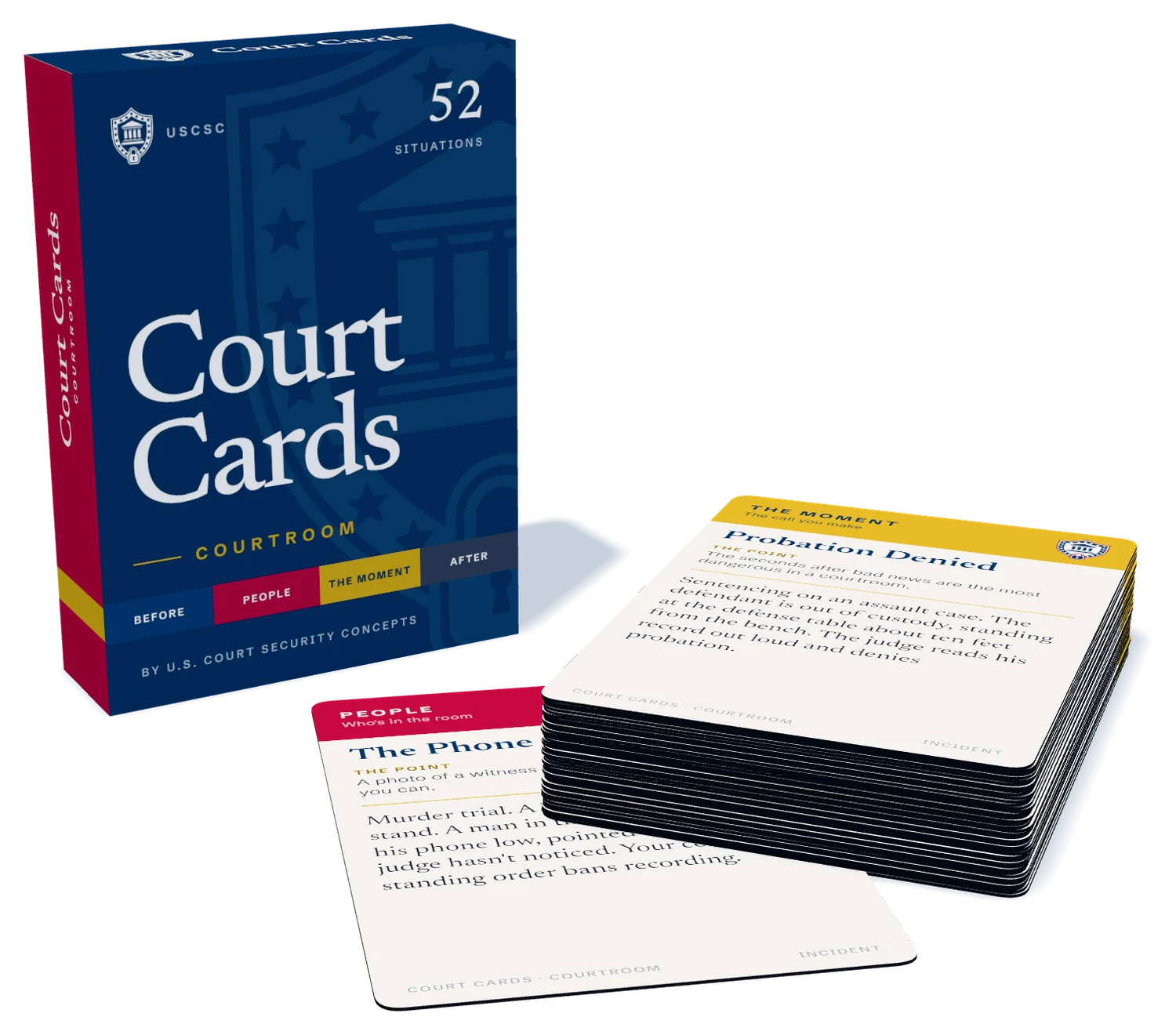
52 courtroom situations, plus 2 cards on how to use them.
Send this to your supervisor
Hip-pocket training.
No classroom and no slides. A short lesson in the lull, from the officer standing next to you.
Pull one in the downtime.
Between dockets, at the screening station, in the office. Fifty-two courtroom calls that ride in a shirt pocket.
Work the call. Then turn it over.
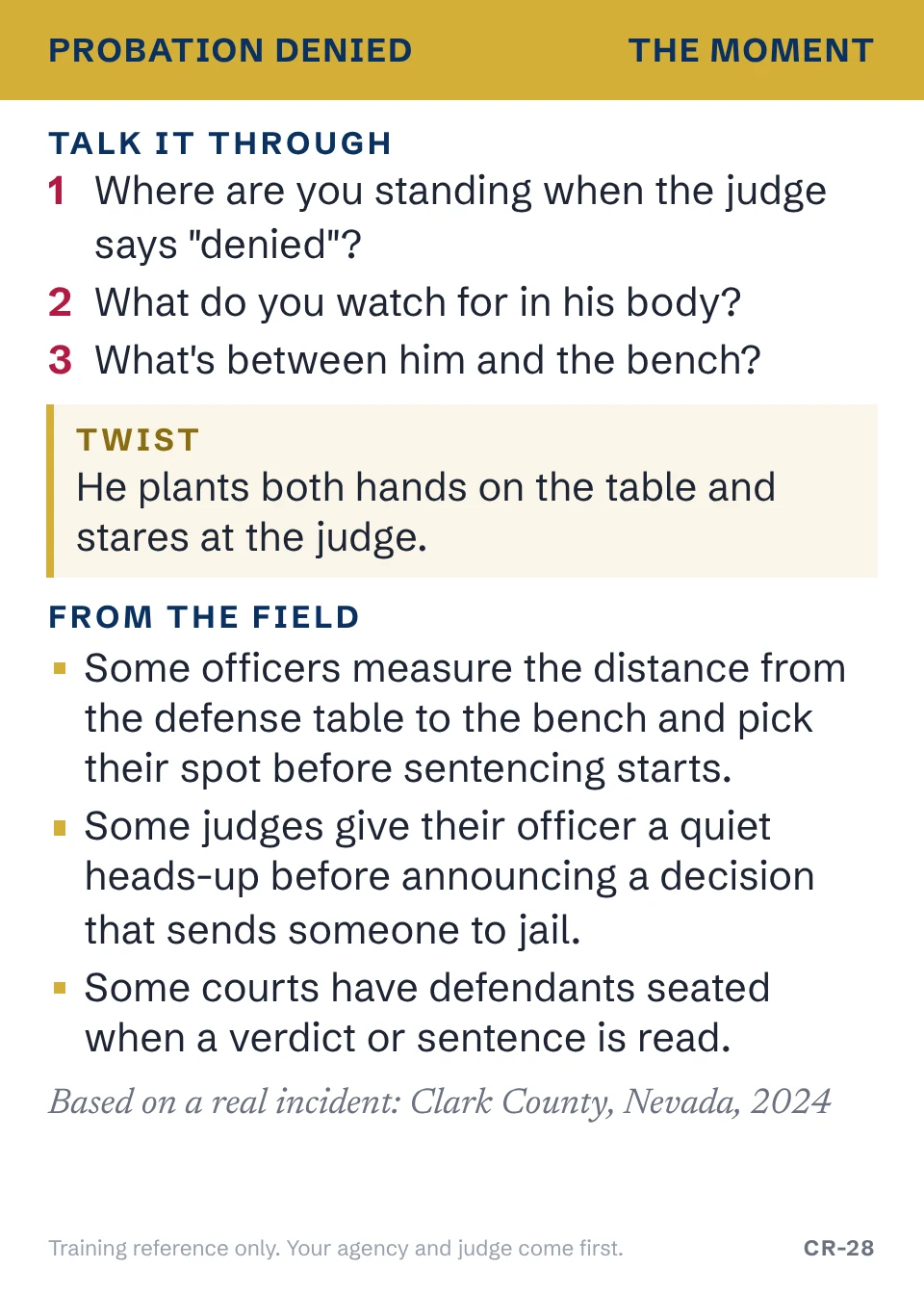
Three questions, a twist, and what other officers have tried. The answer comes from your team.




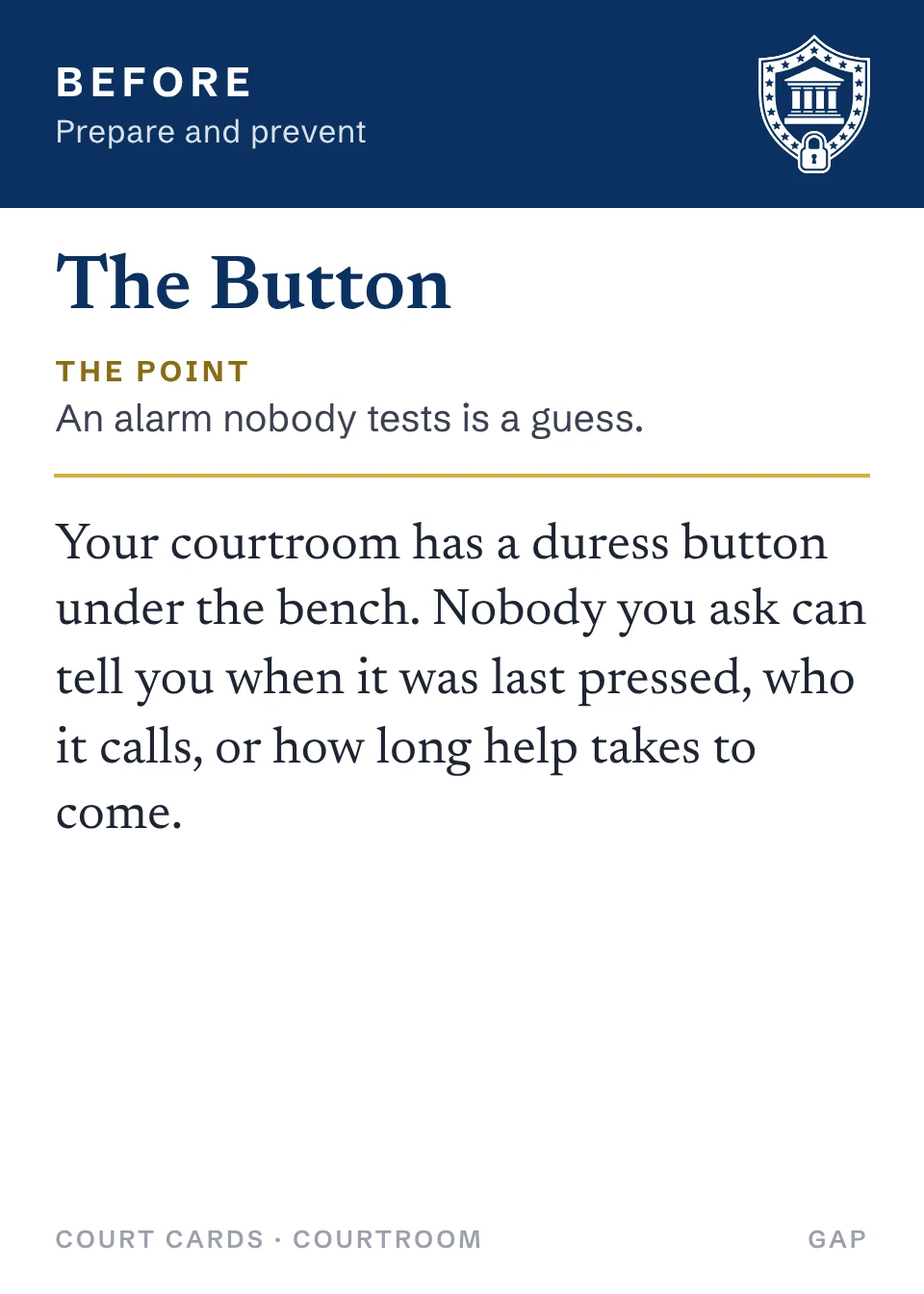
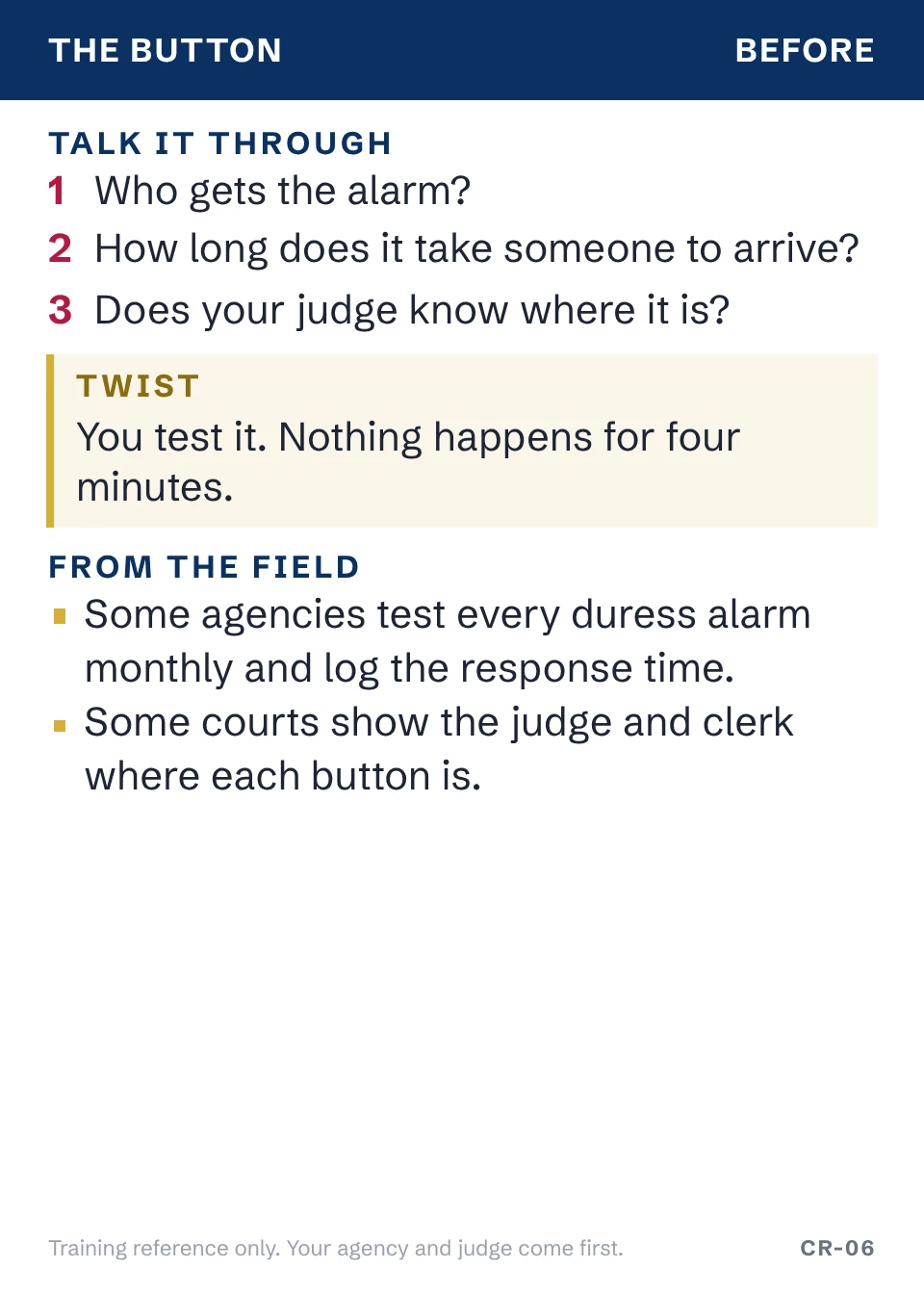
Every word is there for a reason.
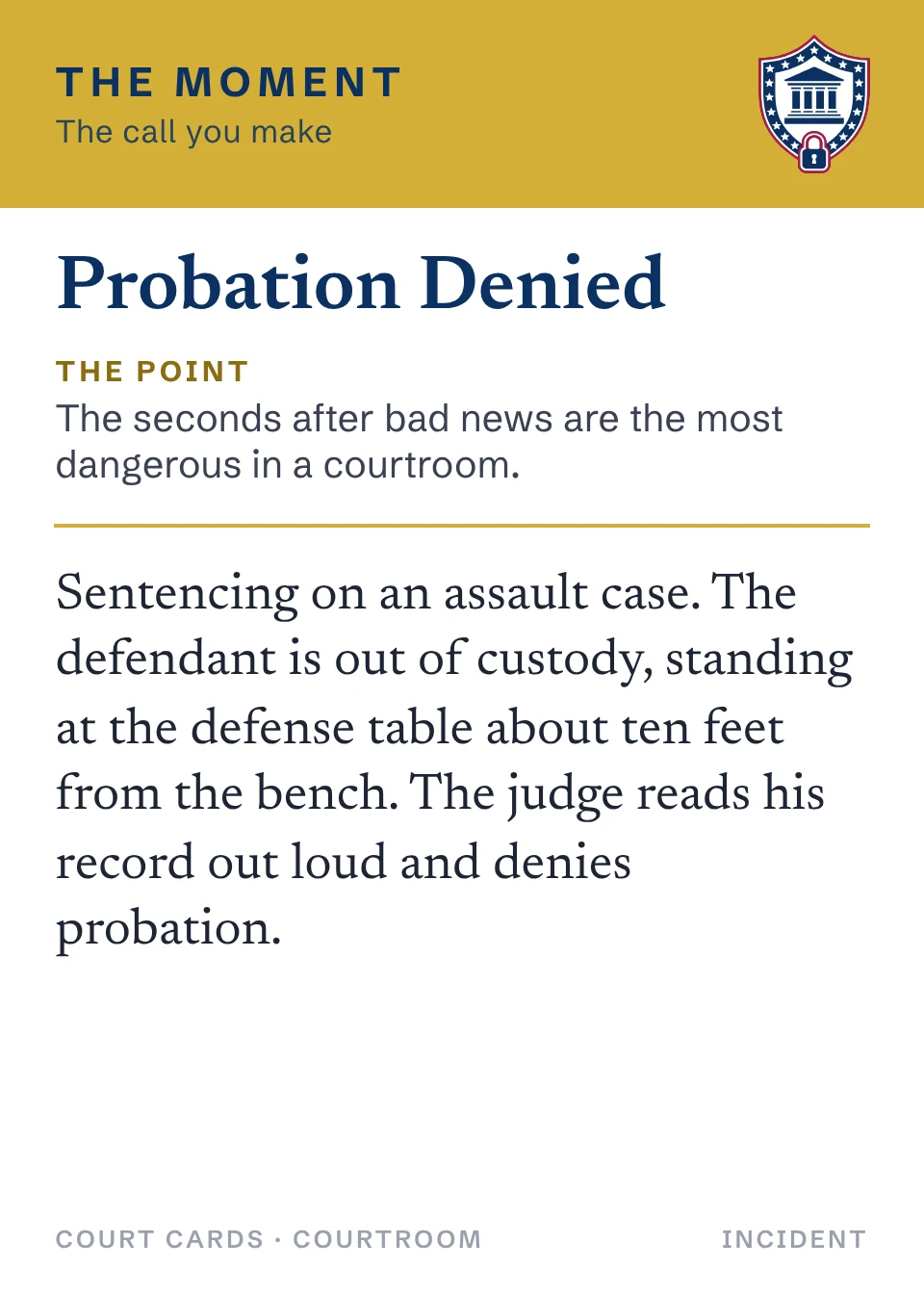
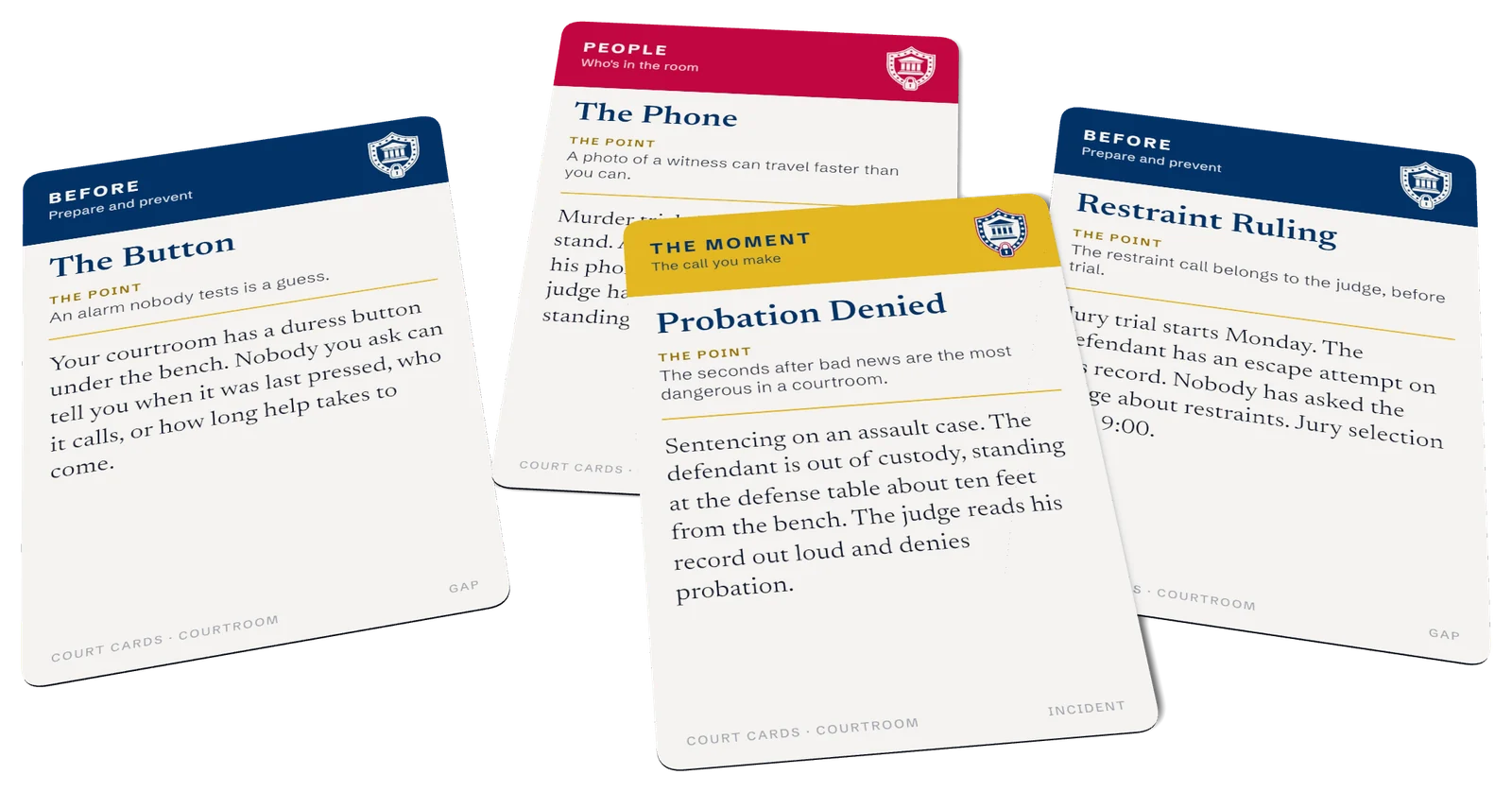
The details that change the call are on the card on purpose. Here's how an instructor reads one.
- The Moment. The color and label tell your team where they are in the court day: before, with the people in the room, the call itself, or after.
- Out of custody. Nothing between the defendant and the room. No restraints and no escort.
- Ten feet from the bench. A few steps. Where you're standing decides who gets there first.
- Denies probation. The second the defendant learns it's jail. That's the call this card is about.
Every card works the same way.
Three more from the deck. Swipe for the next one, tap a card to see the back.
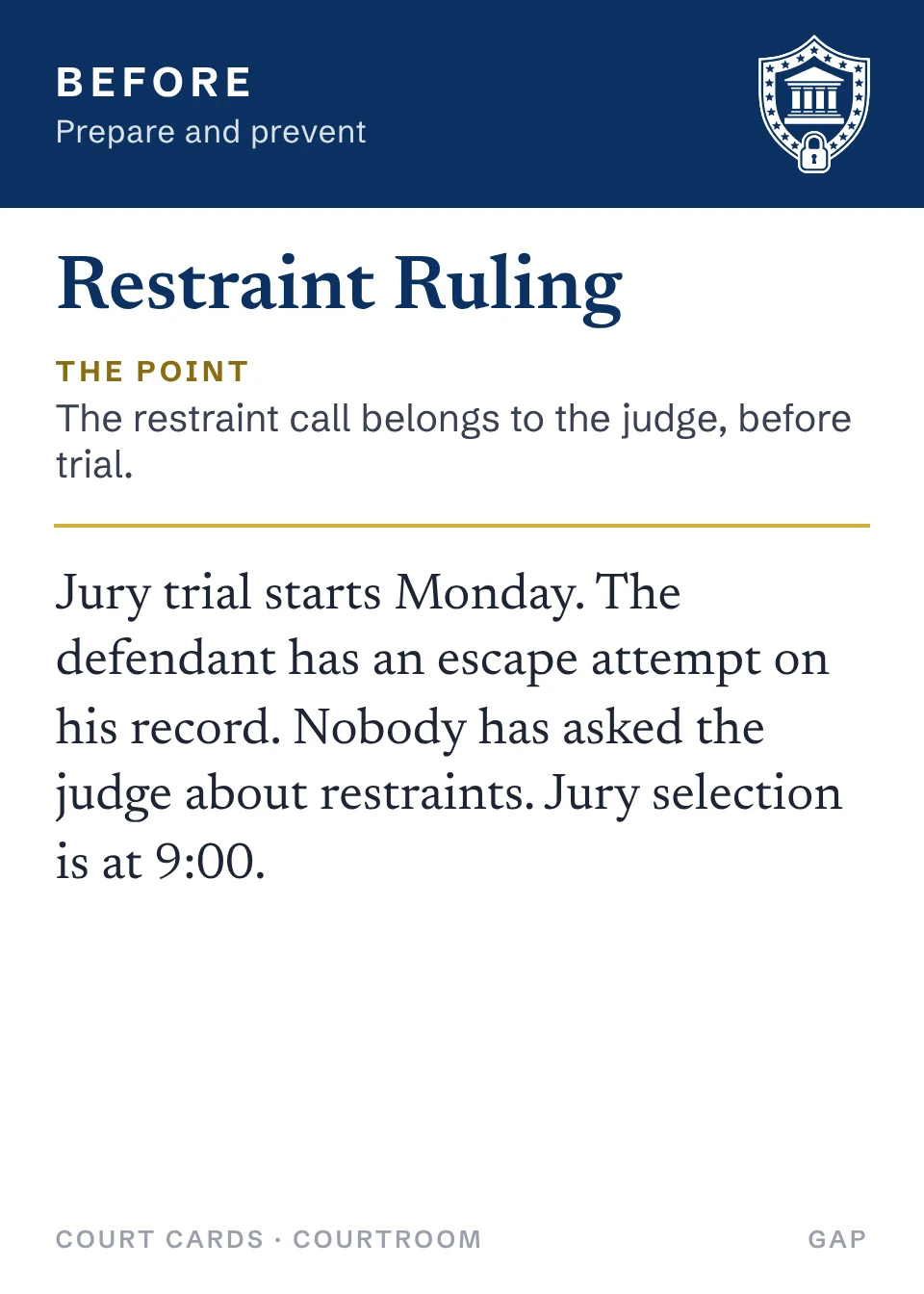
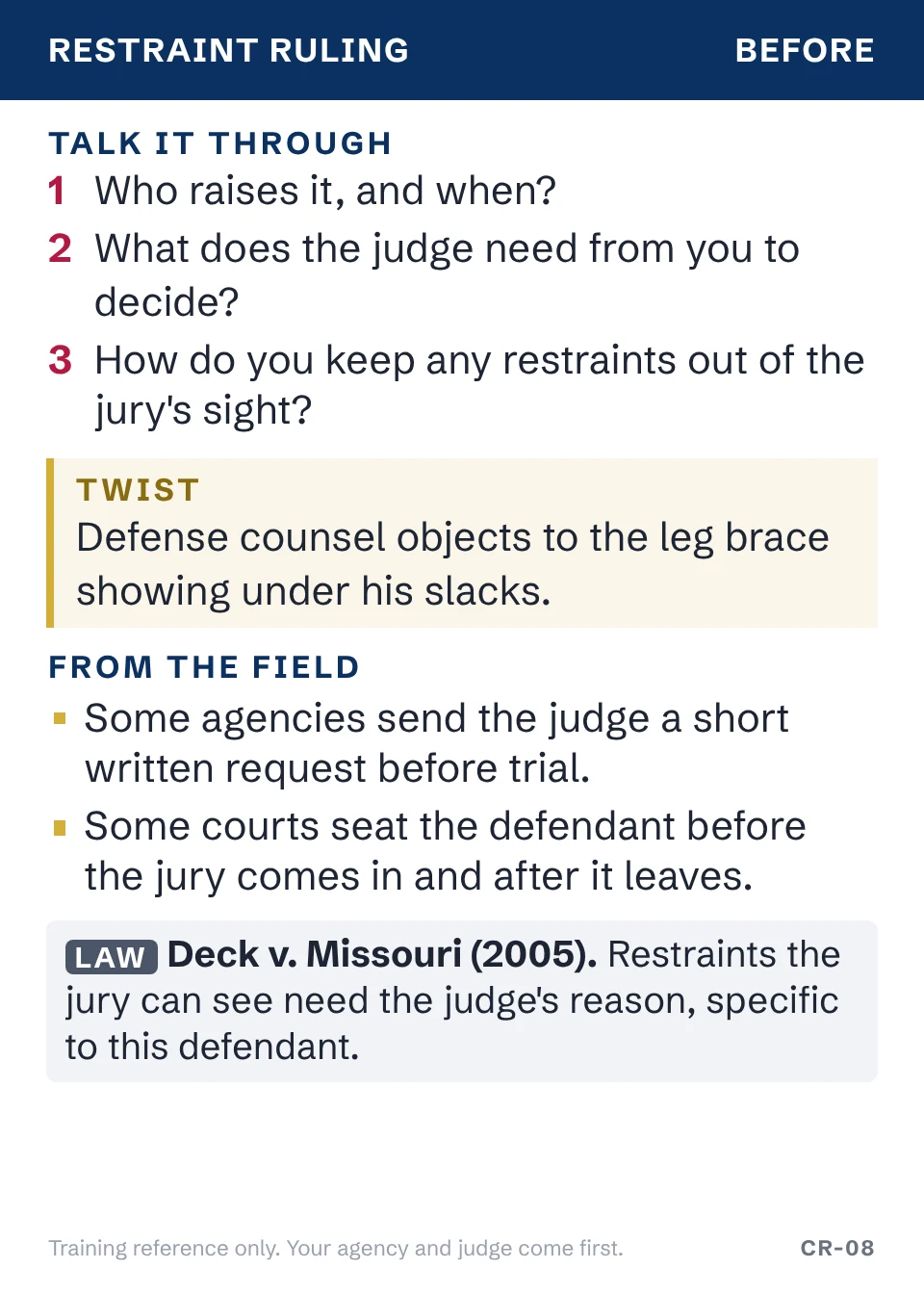
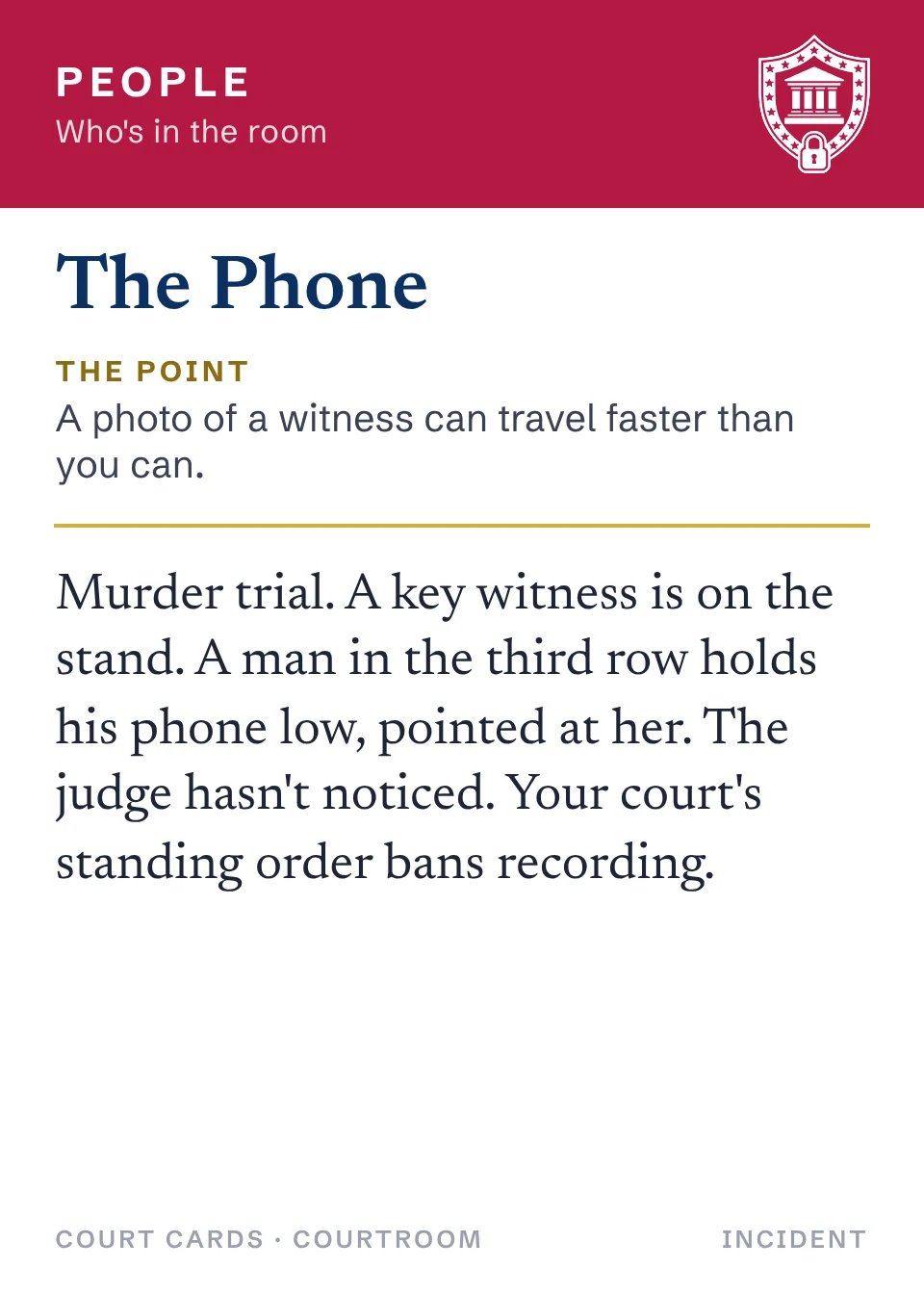
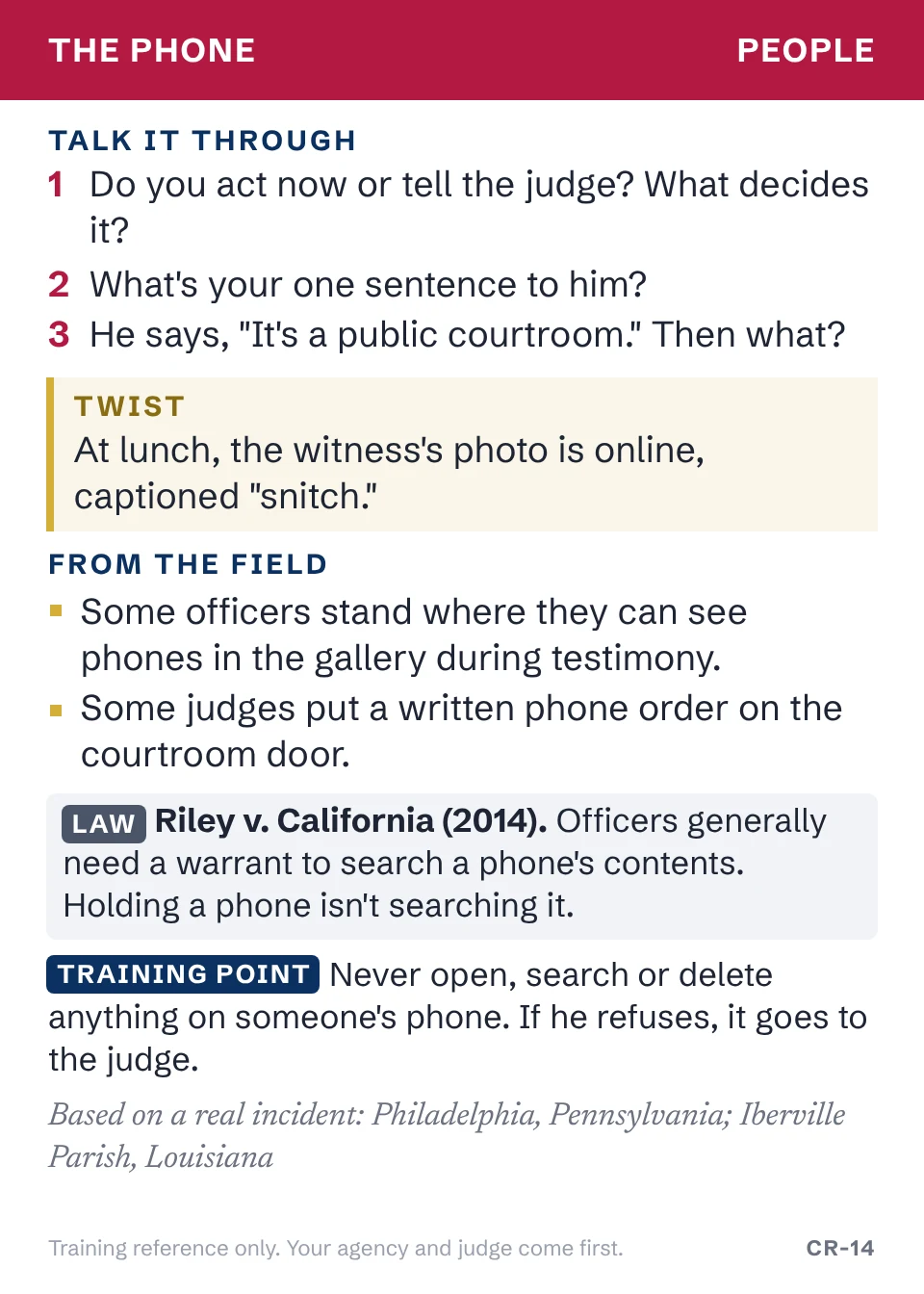
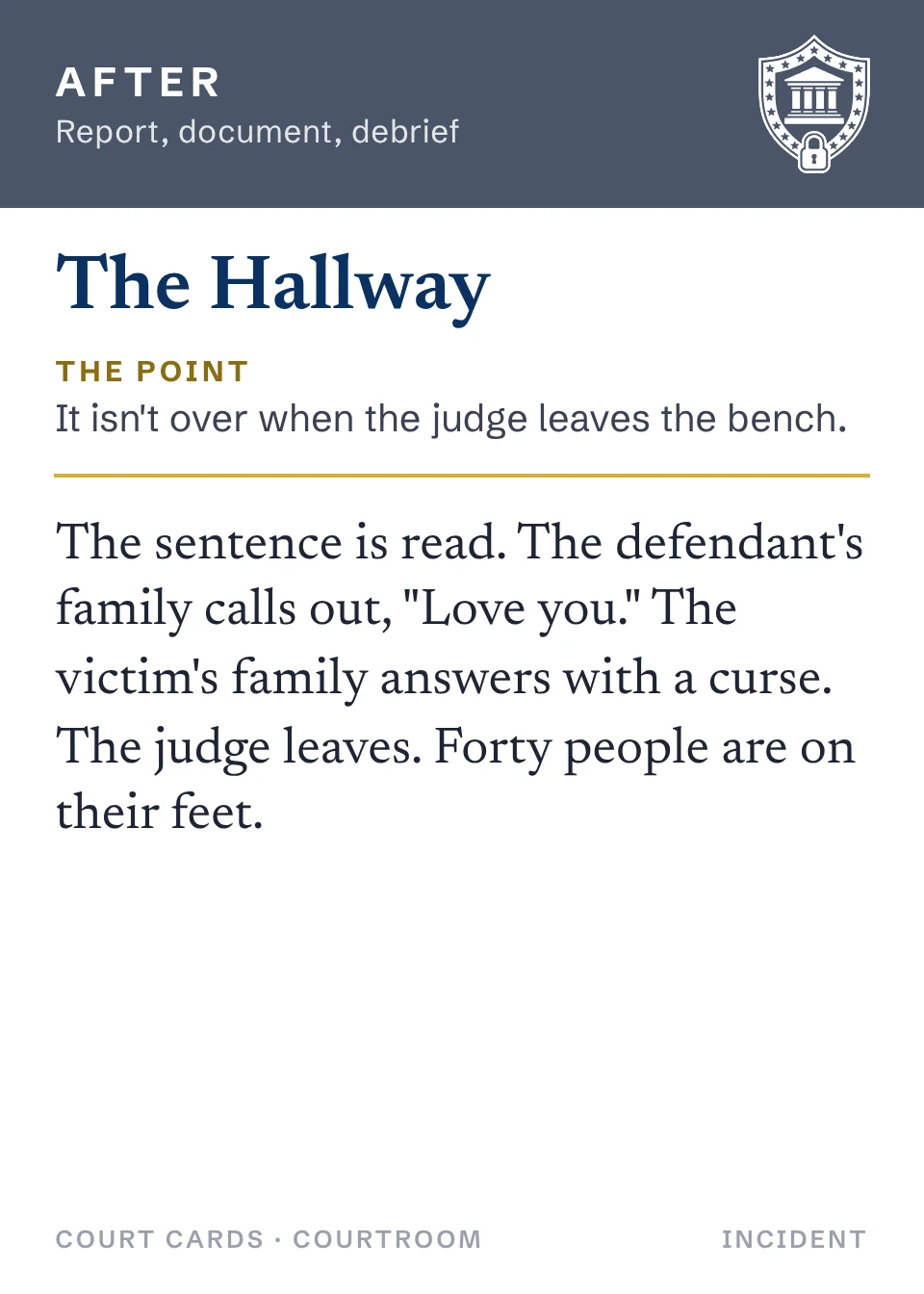
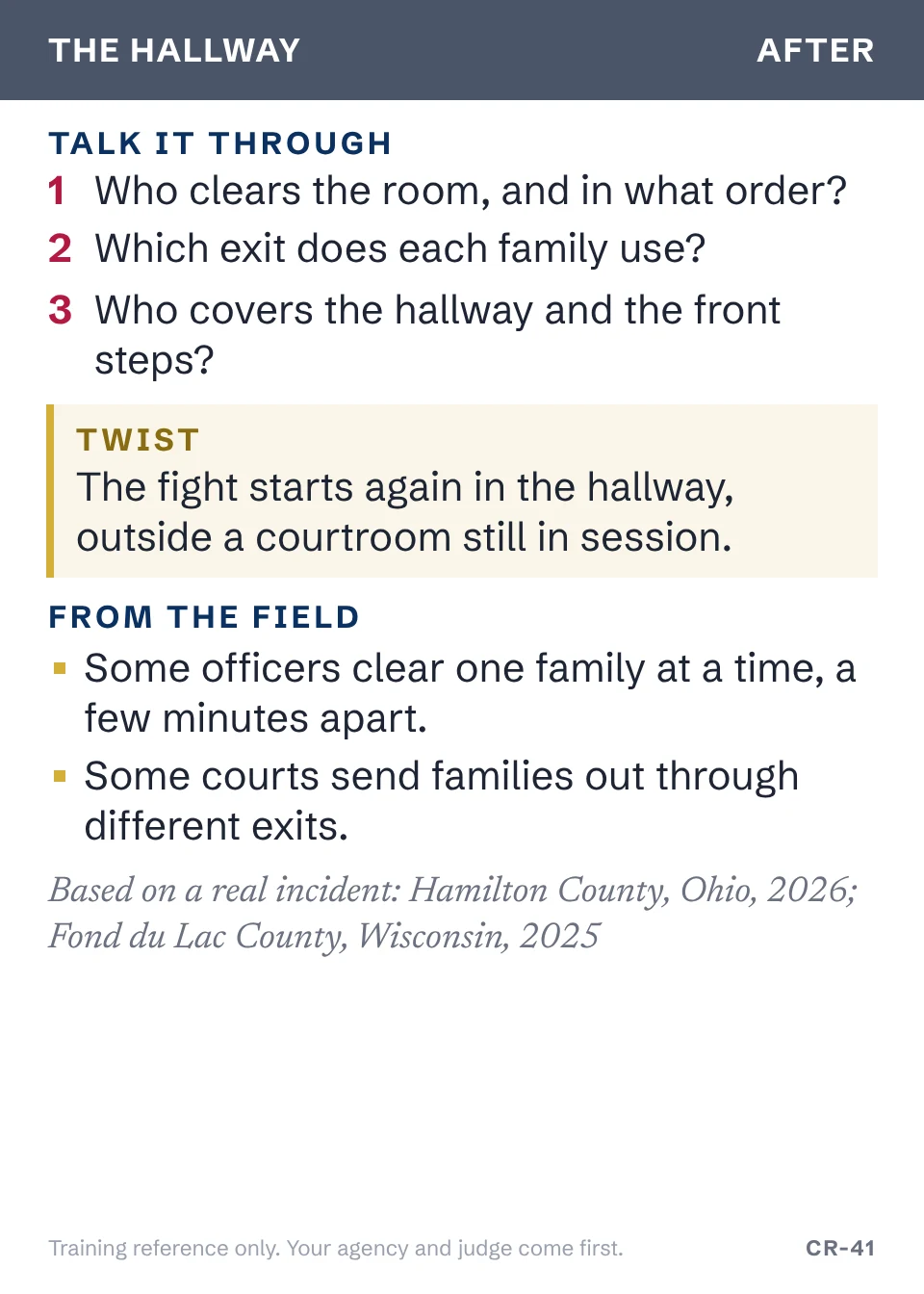
What a deck does for your team.
Training that happens.
Between classes, most teams don't train at all. Pull a card and the conversation starts.
You see how your people think.
Before it matters, you hear who has a plan, who's guessing and who's never thought about it.
Built from real courtrooms.
Many cards are drawn from incidents in courtrooms across the country, written so any court can use them.
Calm comes from reps.
One situation at a time, talked through out loud, is how a steady response gets built.
Downtime breeds complacency.
You can't eliminate it. You can manage it. Court days have long quiet stretches, and that's when routine turns into shortcuts and situational awareness slips. Complacency kills readiness.
Awareness
Recognize it early, in your own work and in the officer beside you. A card at roll call is a reason to look.
Accountability
Hold yourself to it, and let your team hold you to it. Talking a card through out loud does that.
Action
Pull a card. Walk through what you'd do, then check whether your post is set up for it.
The body can't go where the brain has never been. That's why we rehearse.
Guy Beveridge, lead instructor
Built for the five minutes you already have.
Pick a card. Read it out loud. Talk it through.
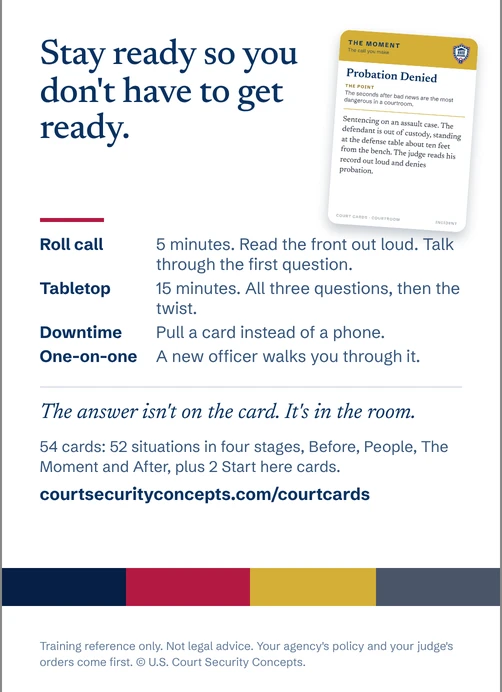
Roll call
5 minutesRead the front out loud. Talk through the first question before the docket starts.
Tabletop
15 minutesAll three questions, then the twist. Watch how the answers change.
Downtime
Any quiet stretchBetween dockets or during a long deliberation, pull a card instead of a phone.
One-on-one
Any timeHand a card to a new officer and have them walk you through it. You'll learn how they think.
 1234
- Comes in a box like a deck of playing cards. Fits a duty bag, a desk drawer or a pocket.
- Color-coded by part of the court day: Before, People, The Moment, After.
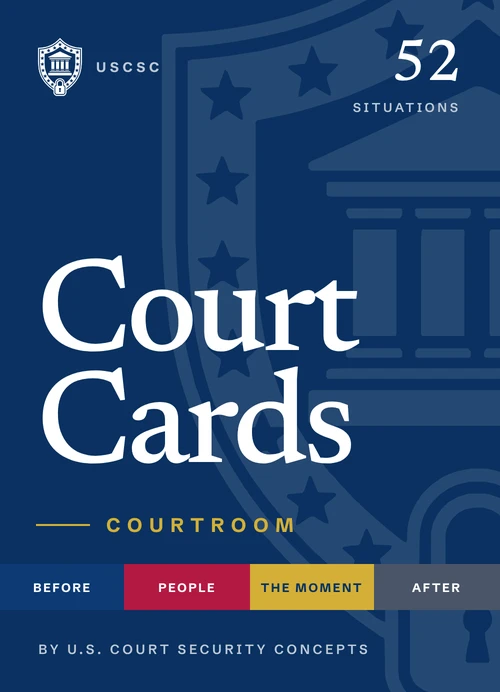
- 52 courtroom situations, plus 2 cards on how to use them.
- Pocket size, 2.5 by 3.5 inches.
52 situations across a full court day.
Thirteen cards in each part, for justice, municipal, county, district, family, juvenile and probate courts. Drawn from real incidents, common gaps and what other courts do well.
BeforePrepare and prevent
The pre-session sweep, the seating chart, the duress button nobody has tested.
PeopleWho's in the room
Someone filming a witness, a defendant with no lawyer, the sixteen-year-old and a parent.
The MomentThe call you make
The verdict, the remand, the order to remove someone who isn't fighting.
AfterReport, document, debrief
The write-up, the video that overwrites in a week, the talk with your judge.
The answer isn't on the card. It's in the room.
Every court runs differently, and the right call is the one your agency and your judge would back. So the cards don't hand you an answer. They hand your team the situation and the hard questions. The answer you work out together is the one you'll reach for when it happens.
Buying for your whole team?
We'll invoice your agency or court and work with your purchase order. Tell us how many and we'll email an invoice. Courthouse security funds may cover them; your county auditor makes that call.
Questions
When does it ship?
January. If we can ship sooner, we will. Nothing is charged until pre-orders open. You pay when you order.
Where does it ship?
U.S. addresses only.
Can I cancel?
Yes. Once you've ordered, you can cancel any time before it ships for a full refund. Email guy@courtsecurityconcepts.com or call 254-423-5675.
How big is it?
The size of a standard deck of cards, 2.5 by 3.5 inches. It fits a shirt pocket, a pants pocket or a duty bag.
Is this legal advice?
No. It's a training reference. Your agency's policy and your judge's orders come first. Where a card names a court decision, read the full case and ask your county or district attorney how it applies to you.
Does it count toward TCOLE hours?
No. It's a training reference, not a course.
Can my agency pay?
Yes. Use the agency form above and we'll send an invoice. Texas law lists continuing education on security issues for court and security personnel among the uses of the courthouse security fund (Code of Criminal Procedure, Art. 102.017). Whether these cards qualify is up to your commissioners court or county auditor.
Five minutes at roll call beats five seconds of guessing.
Get the class price.
Leave your name and email. When pre-orders open, we'll send your class code. It's good for 7 days. Then one more email when the decks ship.